(PREVIOUSLY POSTED IN DP)
1. What skills have you developed through this module and how effectively do you think you have applied them?
I believe that I have learnt how to work with an idea and successfully push and develop it to a product, which got me thinking more and more about the possibilities. I’ve also further developed skills into researching and categorizing which acted as the main foundation for my collection 100 brief.
2. What approaches to/methods of research have you developed and how have they informed your design development process?
Collecting and categorising information and imagery was the only thing driving the last brief. I found that through a clear organised list I was able to structure and clearly identify my findings. The sorting of this information was essential to the final make.
3. What strengths can you identify in your work and how have/will you capitalise on these?
I think the main strength throughout this module was 100 brief. Although the image had to speed up towards the end I was really pleased with the paint effect at the start of the timeline. I found that given the time I was able to develop some more skills in Photoshop painting and try a few different techniques within the program.
I think the work done in Photoshop will aid later briefs, as I can take any initial ideas and begin to develop them further in PS.
4. What weaknesses can you identify in your work and how will you address these more fully?
Time has been a big issue with this module. Especially with the collection 100 project, as it took a very long time to find that initial idea. This is definitely something I’ll have to work on and look at ways to get that idea out there quicker.
5. Identify five things that you will do differently next time and what do you expect to gain from doing these?
Possibly look at testing more initial ideas/variations
Print out things as I go. Found that you can spend too much time on details and find that they cant even be seen when it comes to print!
Looking into creating a hard back cover. Time was an issue and there was a few issue to covering the timeline due to an oversight in its design.
Try different materials to see strengths and weaknesses appropriate to intended use.
Work more on blogs and sketchbook work. Stop seeing the end product as main target.
6.
Attendance 5
Punctuality 4
Motivation 4
Commitment 4
Quantity of work produced 4
Contribution to the group 3
Showing posts with label OUGD102. Show all posts
Showing posts with label OUGD102. Show all posts
Sunday, 21 February 2010

Monday, 1 February 2010
Sunday, 17 January 2010
1. 3 door
2. 5 door
3. Engine Sizes
4. Colour Ranges
5. Standard Wheel Sizes
6. Economy
7. Co2 Emissions
8. Price/affordability
9. No. Of models in range
10. Practicality
11. Dimensions
12. Target Markets
13. Age Groups
14. Timelines Mk1- current
15. Features
16. Safety Ratings
17. Make/Model
18. Year of manufacture
19. Gear Ratio
20. Hardtop/soft top
21. Petrol or diesel
22. Hybrids
23. Interior Features
24. Green Rating
25. Cost per mile
26. Service costs
27. Insurance groups
28. Retained value
29. Average MPG
30. Tank Range
31. Power BHP
32. Pulling power (torque)
33. 0-60
34. Max Speeds
35. Auto or Manual
36. Metallic paint / cost
37. Air Con or Climate Control
38. ESP
39. Number of airbags
40. Traction Y/N
41. Electric Windows
42. CD Single or Multi changer
43. MP3 connection
44. Bluetooth
45. Sat Navigation
46. Country there made in
47. Cup holders
48. Number of speakers
49. Mark of models
50. Standard Features
51. In car storage
52. Number of paint options
53. Rear Legroom
54. Innovative new features
55. Trim levels
56. Readability scores
57. Numbers sold
58. Mirrors Electric/Manual
59. Alloys or steelies
60. Auto switch headlights
61. Keyless entry
62. Folding mirrors
63. Alarms/Security
64. Fog lamps
65. Xenon’s
66. Option to turn airbags off
67. Steering wheel controls
68. C/coded bumpers
69. Window de-misters
70. Fuel consumption display
71. Heated seats
72. Rev counter
73. Range indicator
74. Paddle Shifters
75. Arm rests
76. Fixed/folding rear bench
77. Branded stereo
78. Side skirts
79. Roof rails
80. Cruise control
81. Rear windows – wind/electric
82. Engine cylinders
83. Brakes – drums/discs
84. Min turning circle
85. Weight
86. Kerb Weight
87. Fuel Tank Weight
88. Warranty options
89. Spare Wheels storage
90. Adjustable Steering Wheel
91. Height adjustable seats
92. Average Speed Displays
93. Average Fuel consumption display
94. Temp Gauge
95. Aux inputs
96. Expected depreciation
97. Sun roof
98. Wide angle Windscreens
99. In car storage
100. Hill start Clutch Option
Wednesday, 16 December 2009
Collection 100
Matter
Small Cars
Possible Categories
Make/model, specification, features, colour, target audience (young, older, family ect.)
Research
Magazines, reviews, TV shows, interviews, questionnaires.
Primary
Dealerships, questionnaires, photographs
Secondary
Books, magazines, brochures, flyers, advertising and Internet.
Monday, 14 December 2009
What If Evaluation
We did lots of brainstorming attempting to find fault or a problem with Leeds. We were looking at the idea that the City had lots of unusual architecture and a growth in new design. With this been the strongest idea at the time we each did some research into the buildings around Leeds.
I began by starting to gather a list of the more iconic buildings in Leeds, and researched there floor height’s and square footage to get an idea of how people use the space, as well as how building technology has advanced. What I found was that as time had gone on, buildings were obviously growing in scale which could pose a further issue.
The following day we all got together and soon realised there wasn’t that much scope in this idea. Going back to the drawing board, we started throwing some ideas around, and started simplifying. Looking at Leeds as a busy City, we thought it would be nice to create some quieter areas that people could use to get away from busy city life.
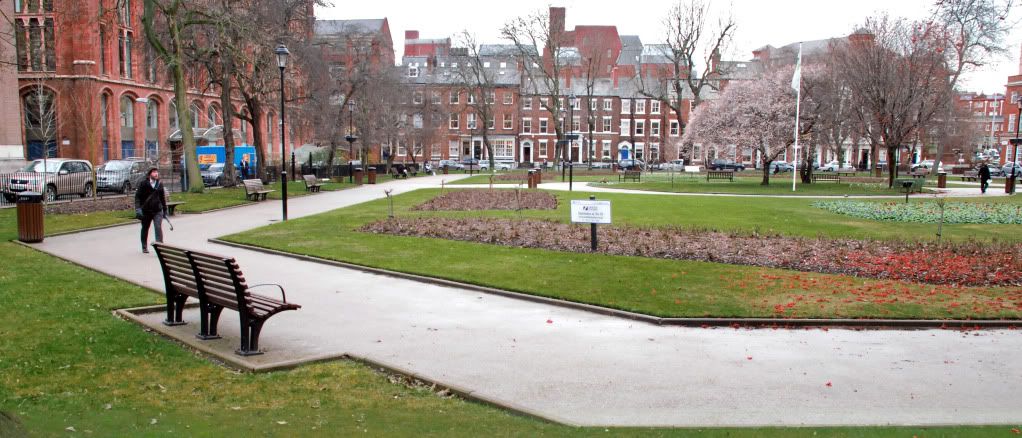
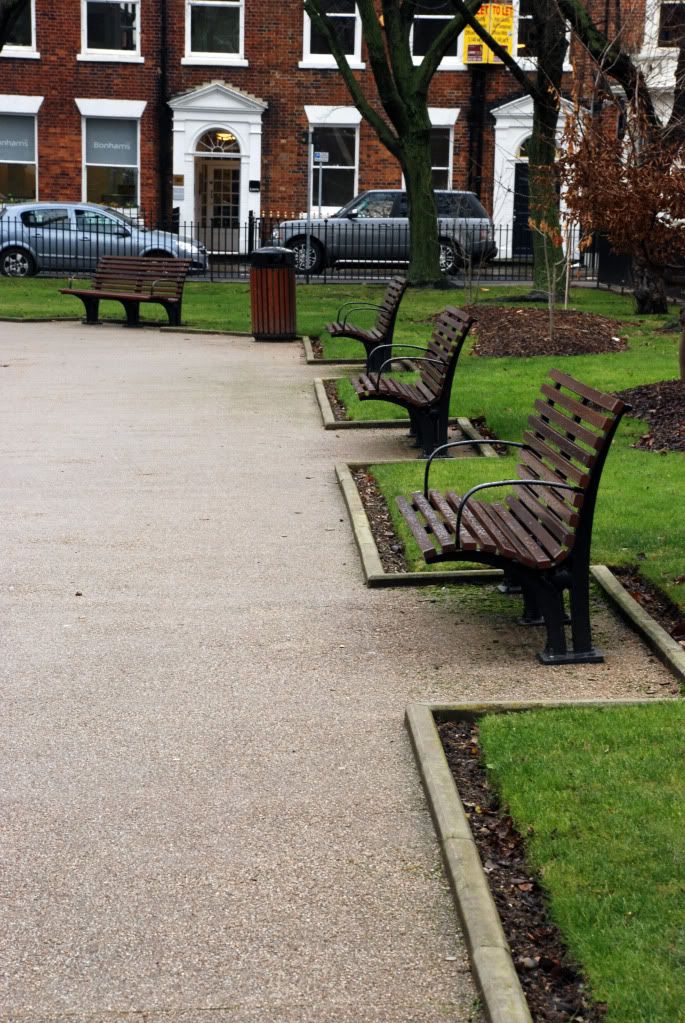
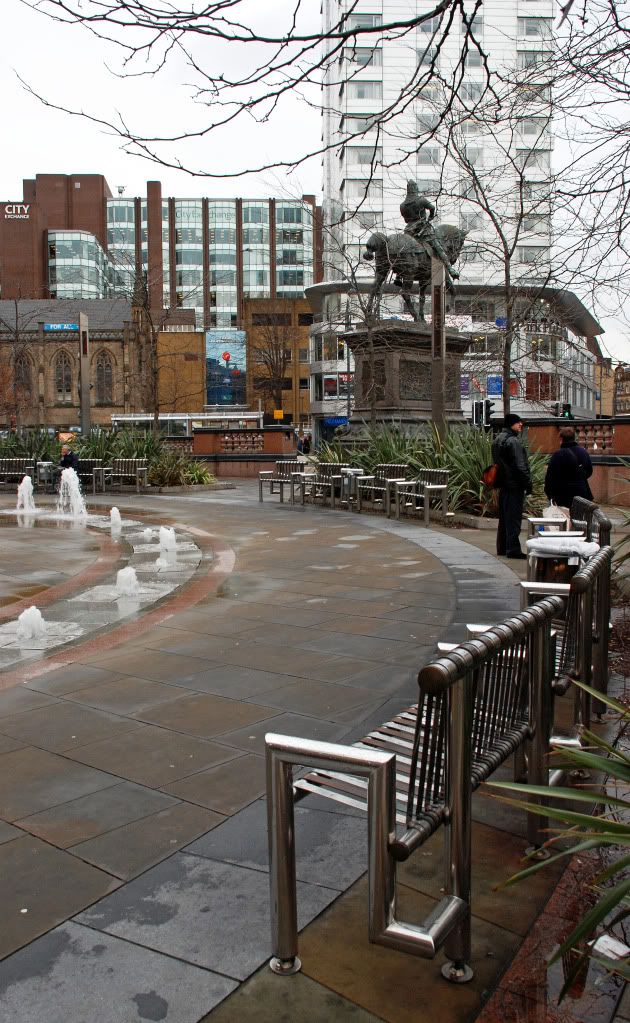
I was given the task of getting in some primary information. I set off around Leeds and started looking for some quiet areas that are currently available in town. This ranged from looking at seating, places of interest and parks. At this point I didn’t want to look up some of the places on the net, I thought I’d just go see if I could find them, just like anyone else in the city. I did come across some places I hadn’t really seen before, but picked up on a pretty important. It’s currently winter and no-one’s using benches or parks. The majority of people spend their time in cafe’s/ coffee shops and so on. This would then make our solution seasonal if we purely chose outdoor spaces.
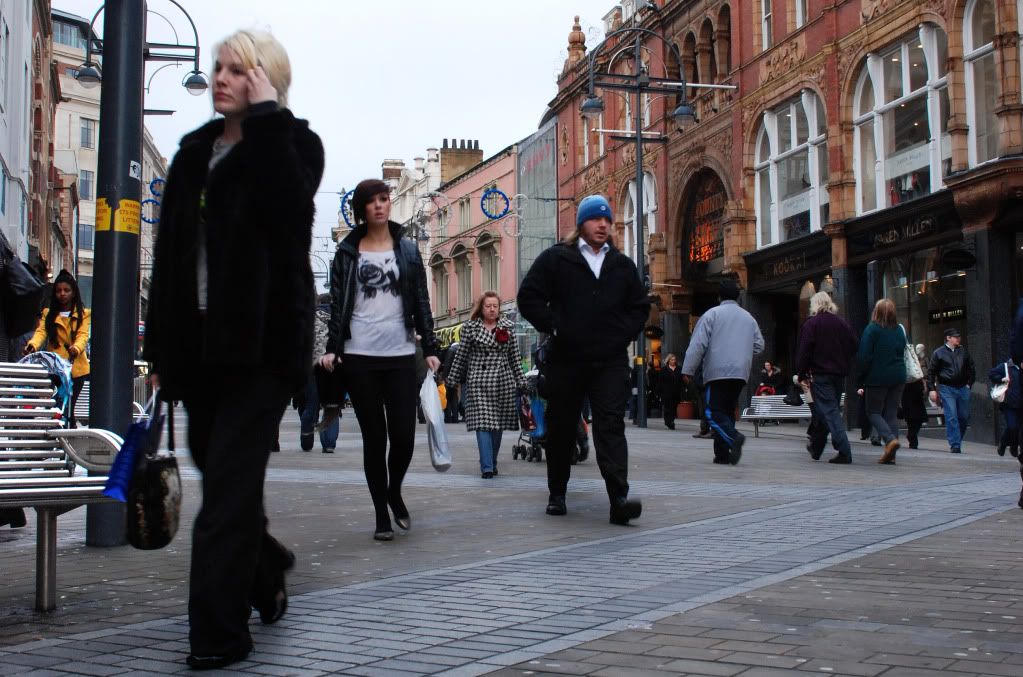
I also found that, as with the coffee shops you do find seating in Leeds but it’s mostly available in the busier areas for people to take a break. The issue with this is that, yes there’s seating, but in no way is it quite. A lot of other green areas within the city were also used for private gardens or property owners.
Below are some of the photographs I took that day;


Some later discussions sparked the idea of using indoor spaces. Arthur suggested the idea of using empty retail stores and converting them into temporary seated areas. We all thought this was a good idea. It was a simple was of effectively using dead space and could also work for getting potential buyers to view the stores as bright open spaces.
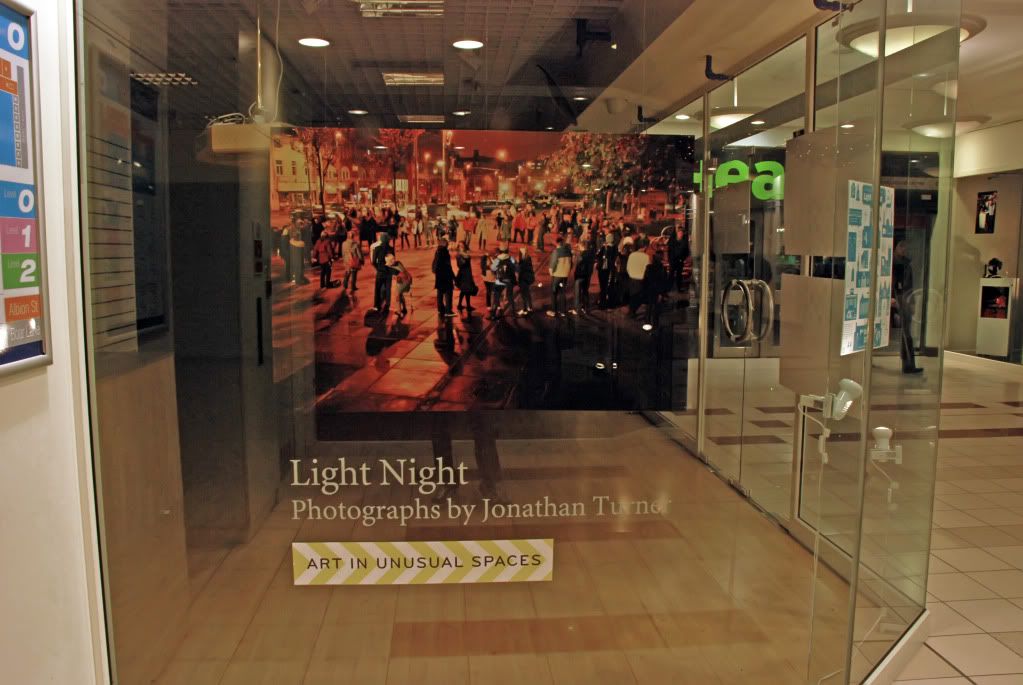
Whilst taking the previous days photos, I came across “Art in Unusual Spaces”. This is government/council funded schemed in which promotes local artists and photographers through empty stores. The stores remain closed and are not open to the public; however the shop fronts are used as display areas for artists to present their work. I later did some secondary research on this, finding that is purely a non-profitable organisation as far as the council is concerned. Its purpose is solely to promote the talent Leeds has to offer.


Here is the concept, used to show seated areas in the disused shops of Leeds;

After the critique, a few issues were addressed which made us turn towards promoting existing quite spots rather than attempting to create our own. I knew from the last time I went out looking for these areas, it’s not so obvious where and how to find these places. I started to take a thorough look into finding the all possible locations in Leeds. The list was compiled using the internet as a secondary source, looking at various web pages.
From this I was left with a list of over fifty possible locations with addresses and contact numbers. Me and Jamie headed off and took a closer look at some of the locations to gain a little more primary evidence. Some of the buildings, including the Town Hall and Civic Hall were not open for general public use and were mainly used as offices; however various events ranging from plays to musical productions are available to see. Some images from the day:


So at this point we knew where the places were, we just needed to figure out the best way of promoting them. To do this we all decided on the idea of ‘things to do, on your lunch hour’. It was discussed that Leeds is obviously a busy city, is there anywhere to escape from it all, specifically on lunch breaks to relieve the stress of a mundane 9-5.
The idea was to be promoted through use of a themed lunch box which would contain a map to the locations near the user. Using City Square as a centre point I went through all the addresses of quiet places of interest and found the distance of each spot to city square. The idea was that all these places would have to be in close walking distance from the user’s place of work.

Above is an image of Nick’s idea for the sandwich box done in illustrator. Above that is my fairly terrible attempt at painting over the image to show the idea a little better, this was soon abandoned.
Using an image of a sandwich, I began to re construct the box around this angle. Initially I tried to make the box a clear plastic but this didn’t work at all and so I ended up making it in a more metallic type surface. I then added a little colour to the strip on the box. As we would have been potentially handing numerous boxes out to the same office, I thought it could be a good idea to have a variation of colours. This way, the user could easily distinguish theirs from another.

The box has City map on the outside of the box to give sense of place and includes the more detailed map under the lid for the ‘quiet locations’.
I definitely found the primary research a lot more useful. There’s a massive difference between looking at things on the net and then actually talking first hand to the people that work in the city. Although secondary is probably the most accessible form of research, in terms of a faster result, it’s hard to tell how accurate it is sometimes, as it’s always one persons point of view.
• It’s good to thoroughly understand the problem before solving it.
• There’s more to research than Google and Wiki
• Research helps identify lots of areas and opens other possible problems you may not have even considered.
• Always keep analysing until your sure what your solving is an actual problem.
• A team leader can really help to structure and support the group work.
I began by starting to gather a list of the more iconic buildings in Leeds, and researched there floor height’s and square footage to get an idea of how people use the space, as well as how building technology has advanced. What I found was that as time had gone on, buildings were obviously growing in scale which could pose a further issue.
The following day we all got together and soon realised there wasn’t that much scope in this idea. Going back to the drawing board, we started throwing some ideas around, and started simplifying. Looking at Leeds as a busy City, we thought it would be nice to create some quieter areas that people could use to get away from busy city life.
I was given the task of getting in some primary information. I set off around Leeds and started looking for some quiet areas that are currently available in town. This ranged from looking at seating, places of interest and parks. At this point I didn’t want to look up some of the places on the net, I thought I’d just go see if I could find them, just like anyone else in the city. I did come across some places I hadn’t really seen before, but picked up on a pretty important. It’s currently winter and no-one’s using benches or parks. The majority of people spend their time in cafe’s/ coffee shops and so on. This would then make our solution seasonal if we purely chose outdoor spaces.
I also found that, as with the coffee shops you do find seating in Leeds but it’s mostly available in the busier areas for people to take a break. The issue with this is that, yes there’s seating, but in no way is it quite. A lot of other green areas within the city were also used for private gardens or property owners.
Below are some of the photographs I took that day;
Some later discussions sparked the idea of using indoor spaces. Arthur suggested the idea of using empty retail stores and converting them into temporary seated areas. We all thought this was a good idea. It was a simple was of effectively using dead space and could also work for getting potential buyers to view the stores as bright open spaces.
Whilst taking the previous days photos, I came across “Art in Unusual Spaces”. This is government/council funded schemed in which promotes local artists and photographers through empty stores. The stores remain closed and are not open to the public; however the shop fronts are used as display areas for artists to present their work. I later did some secondary research on this, finding that is purely a non-profitable organisation as far as the council is concerned. Its purpose is solely to promote the talent Leeds has to offer.
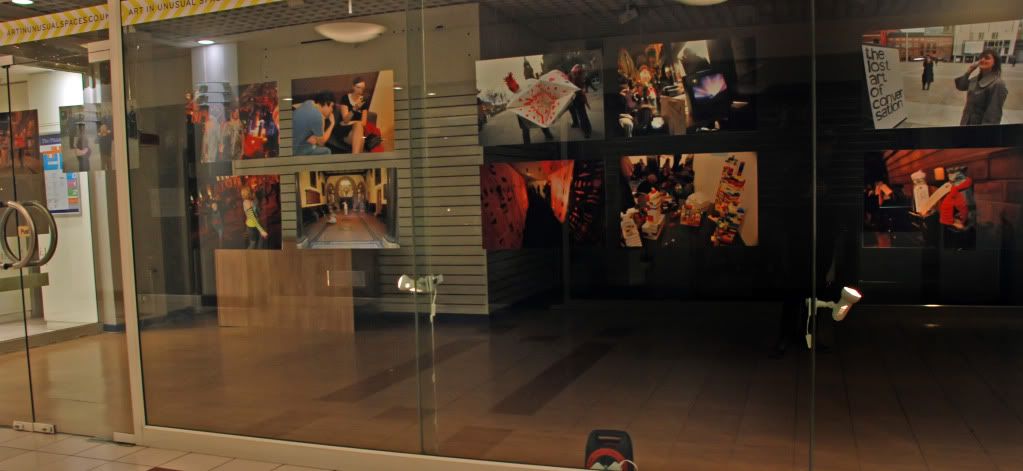
Here is the concept, used to show seated areas in the disused shops of Leeds;
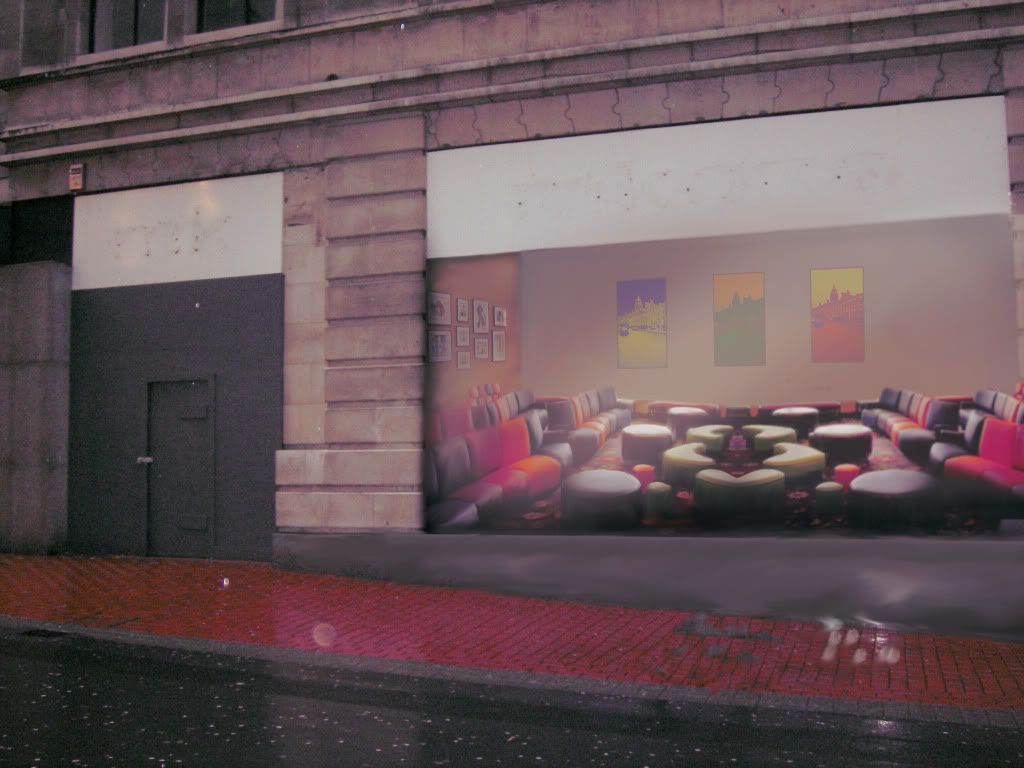
After the critique, a few issues were addressed which made us turn towards promoting existing quite spots rather than attempting to create our own. I knew from the last time I went out looking for these areas, it’s not so obvious where and how to find these places. I started to take a thorough look into finding the all possible locations in Leeds. The list was compiled using the internet as a secondary source, looking at various web pages.
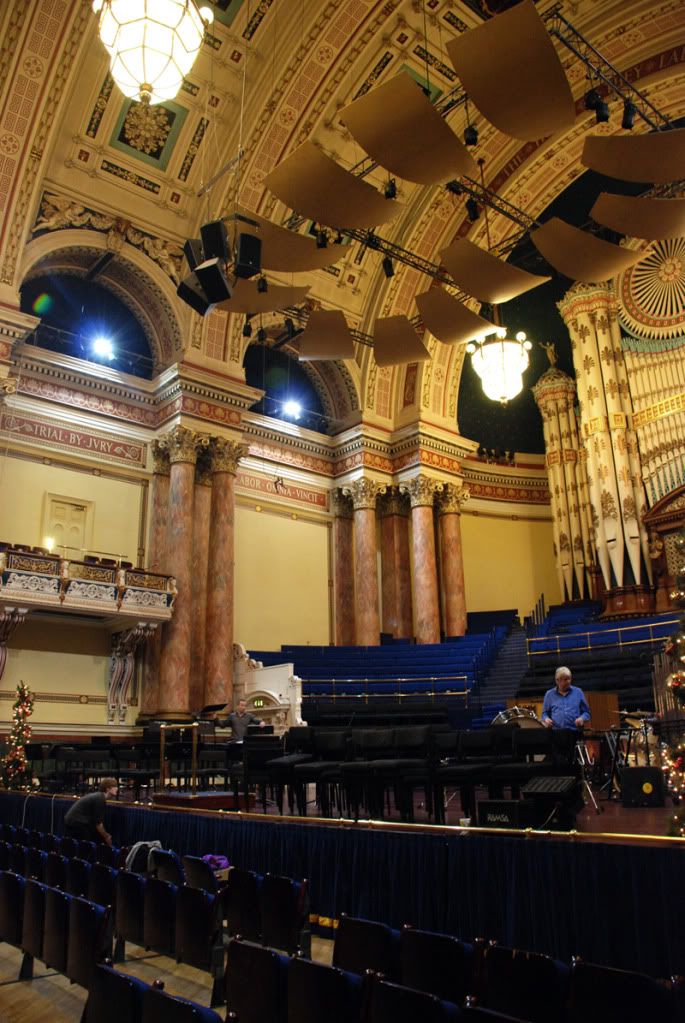
From this I was left with a list of over fifty possible locations with addresses and contact numbers. Me and Jamie headed off and took a closer look at some of the locations to gain a little more primary evidence. Some of the buildings, including the Town Hall and Civic Hall were not open for general public use and were mainly used as offices; however various events ranging from plays to musical productions are available to see. Some images from the day:
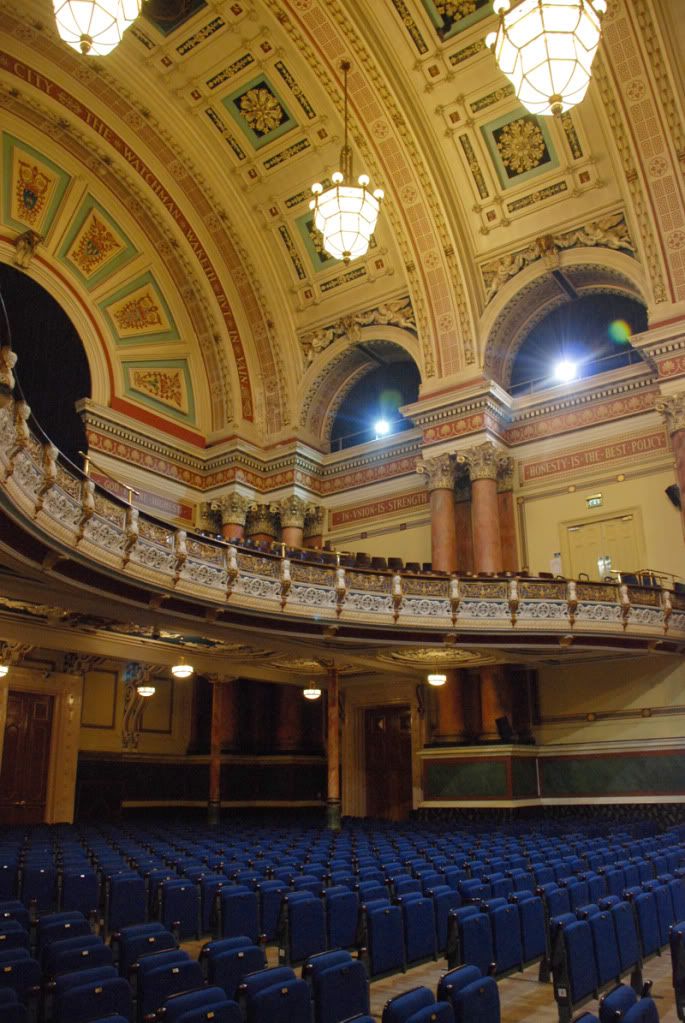
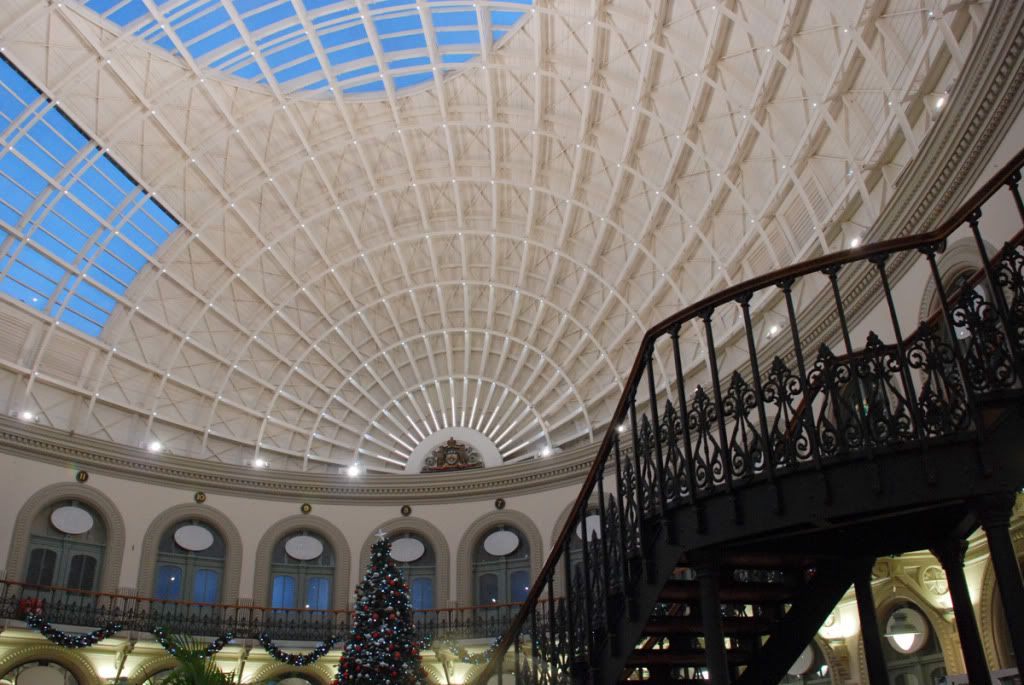
So at this point we knew where the places were, we just needed to figure out the best way of promoting them. To do this we all decided on the idea of ‘things to do, on your lunch hour’. It was discussed that Leeds is obviously a busy city, is there anywhere to escape from it all, specifically on lunch breaks to relieve the stress of a mundane 9-5.
The idea was to be promoted through use of a themed lunch box which would contain a map to the locations near the user. Using City Square as a centre point I went through all the addresses of quiet places of interest and found the distance of each spot to city square. The idea was that all these places would have to be in close walking distance from the user’s place of work.
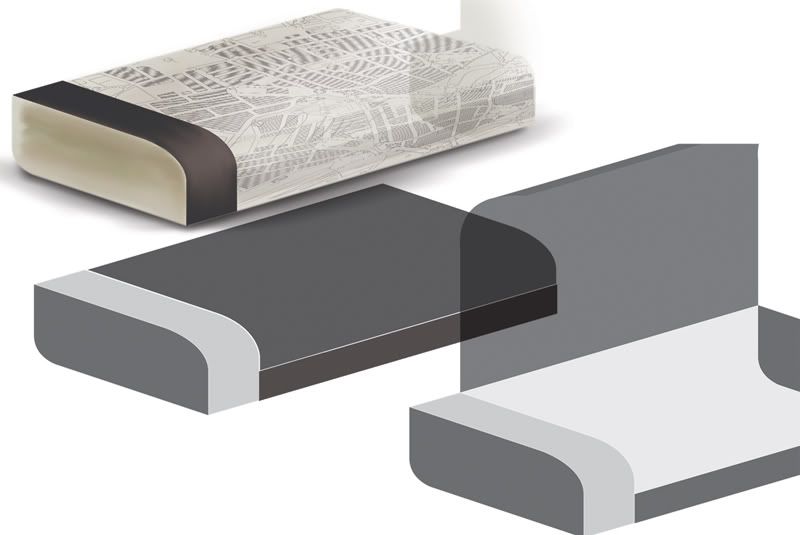
Above is an image of Nick’s idea for the sandwich box done in illustrator. Above that is my fairly terrible attempt at painting over the image to show the idea a little better, this was soon abandoned.
Using an image of a sandwich, I began to re construct the box around this angle. Initially I tried to make the box a clear plastic but this didn’t work at all and so I ended up making it in a more metallic type surface. I then added a little colour to the strip on the box. As we would have been potentially handing numerous boxes out to the same office, I thought it could be a good idea to have a variation of colours. This way, the user could easily distinguish theirs from another.
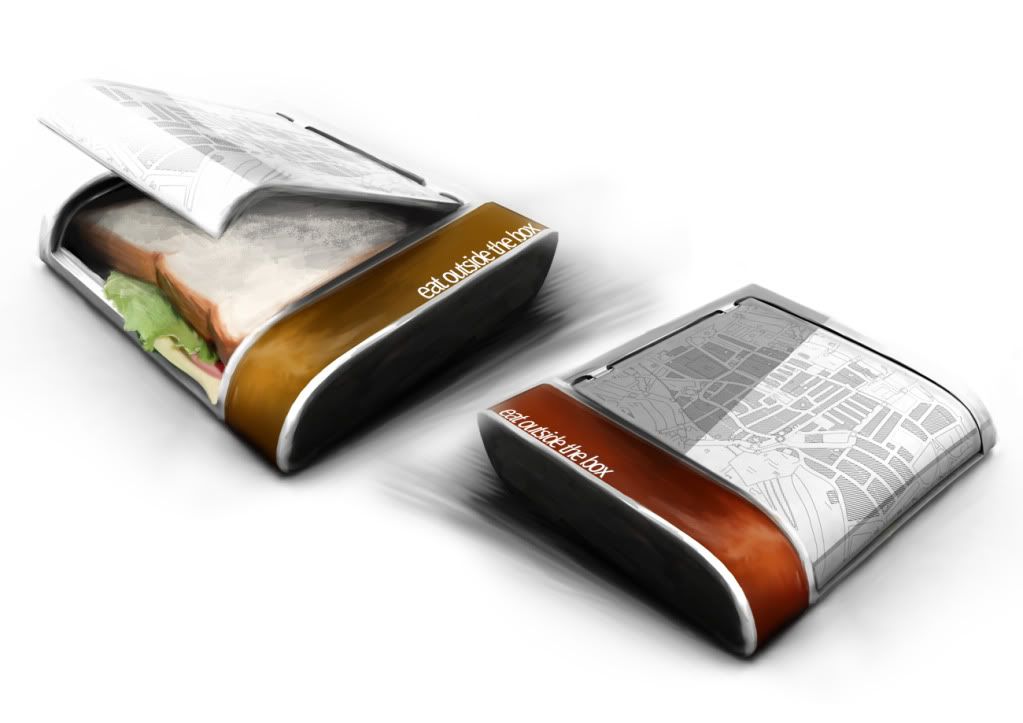
The box has City map on the outside of the box to give sense of place and includes the more detailed map under the lid for the ‘quiet locations’.
I definitely found the primary research a lot more useful. There’s a massive difference between looking at things on the net and then actually talking first hand to the people that work in the city. Although secondary is probably the most accessible form of research, in terms of a faster result, it’s hard to tell how accurate it is sometimes, as it’s always one persons point of view.
• It’s good to thoroughly understand the problem before solving it.
• There’s more to research than Google and Wiki
• Research helps identify lots of areas and opens other possible problems you may not have even considered.
• Always keep analysing until your sure what your solving is an actual problem.
• A team leader can really help to structure and support the group work.
Subscribe to:
Posts (Atom)